Quick Key Takeaways – Gutter Repair
Precision Gutter Repair and Structural Restoration in Topeka, Kansas
Even the highest quality rain gutter system will eventually succumb to wear, structural movement, or storm damage without timely maintenance. In Topeka and surrounding Shawnee County, exterior gutters are constantly tested by severe weather forces: seventy-mile-per-hour prairie thunderstorm winds, summer thermal expansion, autumn tree debris loads, and winter snow and ice damming. Over time, these dynamic forces cause seams to split, spikes to pull free from wood framing, corners to drip, and troughs to lose their downward pitch.
Left unaddressed, minor gutter faults quickly escalate into serious structural issues. Stagnant water overflowing a sagging trough rots exterior fascia boards, damages soffit vents, erodes landscaping beds, and pools around foundation walls, causing basement leaks in Topeka's expansive clay soils. As part of our comprehensive residential and commercial trade services, our field specialists provide thorough diagnostic inspections and targeted, code-compliant gutter repairs that restore hydraulic performance without the cost of unnecessary whole-system replacement.
Whether you need emergency re-attachment after a storm in Lake Sherwood, corner miter resealing in Westboro, or sub-fascia board restoration on a historic home in College Hill, our experienced field crews deliver dependable, lasting repairs.
Common Gutter Failure Modes We Diagnose and Fix
During an on-site service call, our technicians evaluate your entire roof drainage assembly to pinpoint root causes rather than simply applying superficial patches. We routinely diagnose and resolve the following structural failures:
1. Leaking Corner Miters and End Caps
Corner miters are under constant tension as intersecting roof sections expand and contract at different rates during Kansas seasonal temperature swings. Over time, old silicone caulking dries out, cracks, and pulls away from the aluminum surface, allowing water to drip continuously onto walkways or foundation beds. Our repair protocol involves stripping away all old sealant down to bare metal, mechanically securing the joint with stainless steel fasteners, and applying commercial-grade elastomeric polyurethane sealants that maintain flexibility across a wide temperature range. Learn more in our detailed guide on leaking gutters.
2. Sagging Troughs and Loose Spike Fasteners
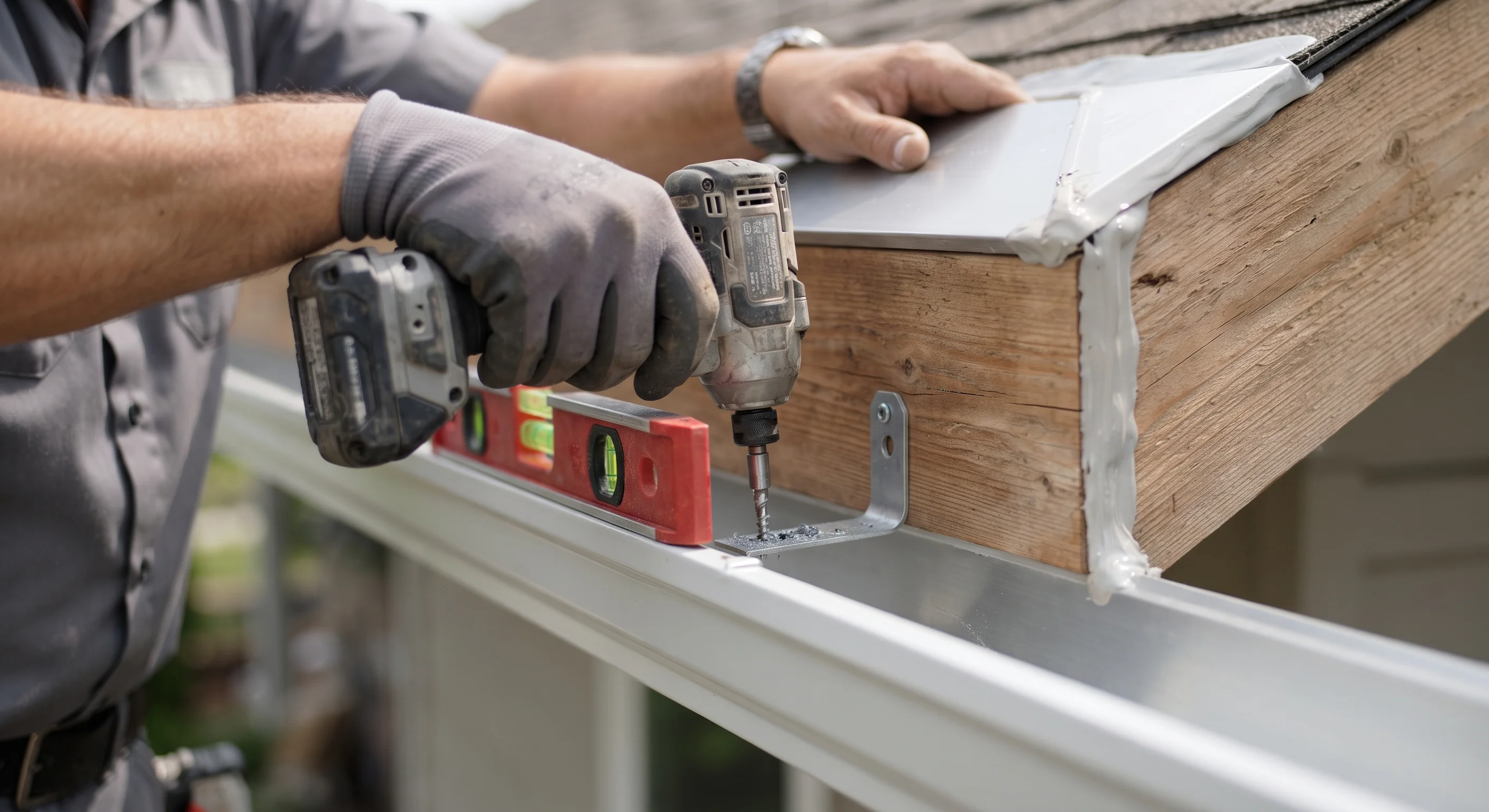
Older gutter systems installed using traditional spikes and ferrules regularly suffer from loose fasteners. As the wood sub-fascia expands and contracts with humidity, the smooth spikes work out of their holes. Once fasteners loosen, the weight of water and debris causes the trough to sag, creating a low pocket where water sits indefinitely. We remove all failing spikes, examine the sub-fascia for hidden rot, and re-anchor the system using heavy-duty hidden screw hangers driven with two-inch structural screws directly into roof rafter tails.
3. Improper Pitch and Standing Water
A gutter must have a consistent downward slope of at least one-quarter inch per ten feet of horizontal run toward the downspout drop outlet. If ground settling or winter ice loads have distorted this pitch, water pools in the middle of the trough, attracting mosquitoes and causing accelerated metal corrosion. Our technicians use digital levels to recalibrate the slope, adjusting hanger elevations along the entire run to ensure rapid, unimpeded water evacuation.
4. Rotted Sub-Fascia and Soffit Damage
When gutters leak from the back lip or overflow because of clogs, water saturates the wood fascia board behind the trough. In many cases, homeowners are unaware that their fascia is completely decayed until a gutter begins pulling away under its own weight. We perform complete structural carpentry repairs, removing rotted wood, installing treated exterior lumber, applying aluminum fascia wrap for moisture defense, and re-mounting the gutter system securely.
5. Detached and Crushed Downspouts
Severe Kansas winds, lawnmower impacts, and heavy ice accumulation frequently disconnect vertical downspouts from their upper drop outlets or dislodge ground elbows. A detached downspout dumps hundreds of gallons of concentrated stormwater directly against foundation footings. We repair or replace damaged sections with heavy-duty 3x4-inch downspouts and secure them using heavy gauge mounting straps.
| Failure Symptom | Underlying Root Cause | Our Technical Repair Procedure |
|---|---|---|
| Corner Seam Drip | Degraded silicone sealant from thermal cycling | Strip old sealant, mechanically refasten, apply elastomeric polyurethane |
| Mid-Span Sagging | Spikes pulled out of sub-fascia under heavy weight | Replace with structural hidden screw hangers into rafter tails |
| Water Behind Trough | Missing, damaged, or un-lapped roof drip edge | Retrofit custom aluminum drip edge flashing beneath shingles |
| Standing Water Pools | Negative pitch caused by building settling or ice | Laser-level recalibration and re-pitching toward drop outlets |
| Loose Eave Trough | Severe sub-fascia wood rot from persistent leaks | Cut out decayed wood, install treated framing, re-mount with structural screws |
| Spilling Over Front Lip | Restricted outlet or undersized trough volume | Ream drop outlet, flush downspout, or upgrade to 6-inch seamless profile |
When to Repair vs. When to Replace Your Gutter System
One of the most frequent questions we receive from Topeka homeowners is whether an aging gutter system can be reliably repaired or if a full gutter replacement is more cost-effective. During our on-site evaluation, our diagnostic technician provides an objective, transparent assessment based on structural criteria:
Repair Is Recommended When:
- Damage is confined to an isolated section (such as a single crushed downspout from vehicle contact or a loose corner miter).
- The aluminum troughs are heavy-gauge (.032-inch), structurally sound, and free of widespread corrosion or pinhole leaks.
- The sub-fascia wood framing is solid across more than eighty percent of the roof perimeter.
- The system is relatively modern and can be brought up to code with new hidden screw hangers and a laser re-pitch.
Replacement Is Recommended When:
- The system consists of old sectional pieces with failing joints every ten feet throughout the entire property.
- Widespread corrosion, rust pitting, or multiple puncture wounds are evident along the bottom of the troughs.
- Extensive hail storms have severely dented, twisted, or crushed the front lip across multiple elevations.
- Widespread sub-fascia rot requires detaching the entire system to replace extensive framing.
- The gutters are undersized 4-inch or lightweight 5-inch troughs that routinely overflow during Kansas thunderstorms, requiring an upgrade to high-capacity seamless gutters.
Review detailed pricing and trade comparisons in our comprehensive gutter repair cost guide.
Step-by-Step Diagnostic and Repair Protocol
Our field technicians follow a systematic repair process to ensure every job delivers lasting performance:
- Safety Setup and Property Protection: We position ladders using padded standoff stabilizers that span beyond the gutter trough, resting safely on the roof deck to avoid denting the aluminum rim. Ground tarps are placed below the work area.
- Debris Clearing and Flush: Before repairs can begin, we clear all leaves, twigs, and organic sludge from the work zone and hydraulically flush the run to observe the exact water flow dynamics and reveal hidden leaks.
- Mechanical Refastening: We remove loose or rusted spikes, align the trough with digital levels, and drive heavy-duty hidden screw hangers through the rear of the gutter into structural rafter tails every twenty-four inches.
- Surface Preparation and Sealant Application: For seam and corner repairs, we wire-brush the aluminum to bare metal, clean it with solvent, and apply thick beads of commercial elastomeric polyurethane sealant over all internal joints and fastener penetrations.
- Operational Flow Verification: Once sealants have skinned and structural fasteners are torqued, we run a controlled water flow test to verify that runoff moves swiftly toward downspouts with zero pooling or perimeter dripping.
- Magnetic Fastener Sweep: A technician sweeps all surrounding turf, garden beds, and driveways with an industrial magnetic roller to ensure no stray screws or metal shavings remain on your property.
Preventing Future Failures: Seasonal Maintenance and Protection
Once your gutters are restored to optimal working order, implementing a proactive maintenance routine prevents premature failures. In Topeka neighborhoods with dense tree canopies like College Hill or Potwin Place, annual cleanouts are essential. Decaying organic debris traps moisture, accelerating fastener corrosion and causing gutters to overflow.
To permanently eliminate clogs and minimize future repairs, many property owners choose to install our surgical micro-mesh gutter guards immediately following repair work. These guards prevent leaves, seeds, and pine needles from entering the trough while allowing full water capture during prairie thunderstorms.
To understand seasonal maintenance cycles in Kansas, consult our seasonal maintenance guide for Kansas.
Frequently Asked Questions About Gutter Repair
Can you fix a gutter that pulled completely away from the house in a storm?
Yes. If the aluminum trough itself is not bent or twisted beyond recovery, we can remove the old fasteners, inspect the sub-fascia for wood rot, install new structural backing if needed, and re-mount the gutter securely using heavy-duty hidden screw hangers driven into rafter tails.
Why do my gutters leak right where two sections join together?
Sectional gutters rely on thin caulk joints at every ten-foot or twenty-foot seam. As Kansas temperatures swing from summer heat to winter freezes, the aluminum expands and contracts, breaking the sealant bond. We clean and reseal these seams with commercial-grade polyurethane, or we can replace failing sectional runs with seamless aluminum troughs.
What causes water to drip behind the gutter onto the ground?
Water dripping behind the gutter usually indicates that the metal drip edge flashing installed under the shingles is either missing, damaged, or not extended into the gutter trough. Without proper drip edge overlap, surface tension pulls water backward beneath the decking, rotting the sub-fascia. We can retrofit custom aluminum drip edge flashing to correct this issue.
Schedule Your Gutter Repair Diagnostic Today
Do not allow leaking, sagging, or detached gutters to compromise your home's foundation and exterior framing. Contact our Topeka dispatch desk by phone or visit our contact page to arrange your comprehensive on-site diagnostic assessment and receive a clear, itemized written estimate today.
Transparent Pricing and Assessment Disclosure
Project costs, linear footage rates, and repair estimates displayed or discussed are regional market benchmarks for Topeka, KS and surrounding Shawnee County communities. Estimates are for budgeting purposes only. Actual prices vary based on on-site conditions, fascia integrity, roof pitch, linear footage, corner miters, downspout runs, and accessibility.
Every service visit includes an on-site physical evaluation and a clear written estimate before any physical work commences. No surprise travel fees or unapproved billings.