Quick Key Takeaways – Gutter Guards
High-Performance Gutter Guards and Leaf Protection in Topeka, Kansas
For property owners throughout Topeka and Shawnee County, maintaining free-flowing rain gutters is an ongoing challenge. The city's magnificent urban forest—celebrated in historic neighborhoods like College Hill, Westboro, and Potwin Place—features towering pin oaks, silver maples, cottonwoods, and evergreens. While these mature canopies provide cooling shade and enhance neighborhood beauty, they deposit a continuous stream of organic debris into exterior eaves throughout all four seasons.
Spring brings sticky oak catkins and maple helicopter seeds that slip through coarse screens; summer storms tear green leaves and twigs from high branches; autumn produces a massive shedding of heavy deciduous foliage; and winter freezes turn wet, trapped debris into heavy blocks of ice. Climbing ladders multiple times per year to scoop out rotting organic sludge is hazardous, time-consuming, and exhausting.
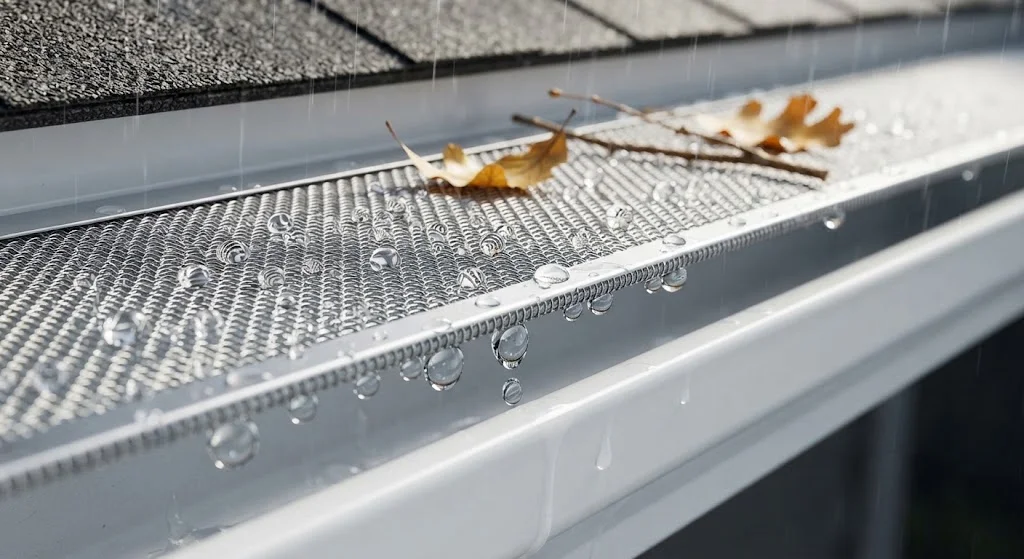
As part of our comprehensive residential and commercial gutter services in Topeka, our field specialists install high-performance micro-mesh gutter guards. Utilizing surgical-grade 316 stainless steel mesh integrated into heavy-duty anodized aluminum frames, our systems block even the smallest debris particles—including pine needles and roof shingle granules—while drawing high-velocity storm runoff directly into the trough via capillary action.
Whether protecting a historic residence or outfitting an expansive roofline near Lake Sherwood, our gutter protection systems eliminate ladder climbing and deliver dependable, year-round water diversion.
Evaluating Gutter Guard Technologies: Why Micro-Mesh Wins
The market for gutter protection includes numerous designs, ranging from inexpensive plastic inserts to bulky reverse-curve covers. However, most retail designs suffer from inherent engineering flaws that lead to frequent failures under Midwest storm conditions:
1. Foam and Brush Inserts
Foam inserts fit inside the gutter trough, theoretically allowing water to seep through while blocking leaves. In practice, roof shingle granules and organic pollen quickly clog the foam's microscopic pores, turning the insert into an impermeable sponge where weeds and seedlings sprout. Brush inserts suffer a similar fate, as oak tassels and pine needles become hopelessly entangled in the bristles, requiring homeowners to pull out the heavy, sludge-filled brushes by hand.
2. Perforated Plastic and Stamped Aluminum Screens
Standard perforated screens feature round or slotted holes that measure one-eighth to one-quarter inch wide. While they block large oak leaves, smaller debris—such as maple seed pods, pine needles, and spring catkins—easily slips through the openings. Once inside the trough, this organic matter decomposes into a thick muck that clogs downspouts beneath the screen, forcing homeowners to remove the screens to clean out the gutter.
3. Solid Reverse-Curve Surface Tension Helmets
Reverse-curve systems rely on water adhesion to guide runoff around a curved nose into a narrow horizontal slit. While effective in light drizzles, high-velocity rainwater from steep Kansas roof pitches often shoots directly over the nose, overshooting the gutter entirely. Furthermore, small twigs and bees frequently enter the open slit, creating hidden blockages inside the trough that cannot be accessed without disassembling the heavy cover.
4. Surgical-Grade Stainless Steel Micro-Mesh (Our Standard)
Micro-mesh systems utilize an ultra-fine surgical stainless steel wire cloth (often featuring fifty to one hundred microscopic openings per linear inch) laminated to a structural anodized aluminum frame. The mesh openings are so minute that only pure water can penetrate; leaves, twigs, seeds, pine needles, and even abrasive roof grit remain on top of the screen, where they dry and blow away naturally in Kansas prairie winds.
| Gutter Guard Technology | Debris Filtration Efficiency | High-Velocity Rainwater Handling | Pine Needle and Seed Defense | Shingle Warranty Compatibility | Expected Lifespan |
|---|---|---|---|---|---|
| Surgical Stainless Micro-Mesh | 99% (blocks roof grit and catkins) | Excellent (capillary surface tension draw) | 100% impenetrable barrier | Installs without lifting or nailing shingles | 25 to 30+ years |
| Reverse-Curve Helmets | 70% (slits collect twigs and pests) | Poor (overshoots on steep Kansas roofs) | Prone to jamming inside horizontal slit | Often nailed directly under roof shingles | 10 to 15 years |
| Perforated Aluminum Screens | 60% (small debris enters holes) | Moderate (handles medium rain flow) | Pine needles and tassels stick vertically | Snapped onto gutter rim or screwed in place | 5 to 10 years |
| Foam and Bristle Inserts | 30% (pores clog rapidly with silt) | Fails rapidly as pores become saturated | Seeds germinate and grow inside foam | Placed completely inside gutter trough | 1 to 3 years |
The Engineering Behind Capillary Action Micro-Mesh
Our micro-mesh systems achieve exceptional water intake without overshooting through the physics of capillary action:
- Surgical 316 Stainless Steel Wire Cloth: We utilize medical-grade 316 stainless steel mesh that is completely impervious to rust, corrosion, and oxidation, even when exposed to decomposing organic leaf acids or coastal air.
- Anodized Aluminum Sub-Frame: The stainless steel mesh is secured into a rigid, extruded anodized aluminum body. This aluminum frame provides structural rigidity, preventing the guard from sagging or bowing under heavy Kansas winter snow and ice loads.
- Downward Capillary Draw: As water flows down the roofline and encounters the micro-mesh, surface tension pulls the water molecules through the microscopic openings and down into the trough below. Even during torrential convective cloudbursts dropping three inches of rain per hour, the system captures full water volume without front-edge sheeting.
- Self-Shedding Convex Pitch: Our technicians install the guards at an optimized angle that aligns with the slope of your roofline. This slight incline ensures that when autumn leaves, twigs, and oak tassels land on the mesh, they cannot form a permanent mat; as soon as the rain stops and the sun dries the debris, typical Kansas winds blow it cleanly off the roof edge.
To learn more about how proper sizing maximizes gutter guard efficiency during storms, read our gutter sizing calculator guide.
Protecting Your Roof Warranty: Non-Invasive Installation
A major concern for homeowners when selecting gutter guards is protecting their existing roof manufacturer's warranty. Many aggressive gutter guard franchises install heavy covers by prying up the first course of asphalt shingles and driving screws through the roof decking or water-resistant underlayment. In addition to creating potential leak paths into your attic, nailing into or modifying shingles can immediately void your roofing manufacturer's warranty.
Our installation protocol is strictly non-invasive:
- Zero Shingle Penetration: We never nail, screw, or adhere gutter guards directly into your roof shingles or roof decking.
- Fascia and Trough Mounting: The front edge of our micro-mesh guard clips securely onto the outer rim of your seamless gutters, while the rear edge is fastened directly to the back wall of the gutter or secured with specialized bracket assemblies that slide gently beneath the shingle overhang without disturbing the tar adhesive strip.
- Drip Edge Integration: Our technicians ensure the guard works in tandem with your existing metal roof drip edge, preventing water from traveling backward behind the fascia board.
If your existing gutters have loose fasteners or improper pitch, our technicians perform necessary gutter repairs before installing guards, ensuring a perfectly aligned foundation.
Winter Performance and Ice Dam Considerations in Kansas
Topeka winters regularly bring freezing rain, heavy snowfall, and rapid freeze-thaw cycles. Property owners frequently ask how micro-mesh gutter guards perform during sub-zero winter conditions.
It is important to understand that no gutter guard can prevent ice dams from forming on an uninsulated roof; ice dams are caused by warm attic air melting snow on the upper roof deck, which then refreezes at the cold eave overhang. However, high-quality micro-mesh guards provide distinct winter advantages:
- Empty Winter Troughs: Because guards prevent wet autumn leaves from clogging the gutter before winter arrives, the trough remains empty of frozen sludge. Meltwater that enters the gutter can flow freely toward downspouts rather than backing up into solid ice blocks.
- Snow Load Resistance: The rigid anodized aluminum frame acts as a structural bridge across the gutter opening, preventing heavy snow loads from crushing or bending the front lip of the trough.
- Heated Cable Compatibility: For homes with persistent thermal bypass issues, our micro-mesh guards are fully compatible with self-regulating de-icing heat cables installed along the eave and inside the downspout.
For comprehensive strategies on safeguarding your roofline this winter, consult our ice dam prevention guide.
Transparent Pricing for Gutter Guards in Topeka
Investing in permanent micro-mesh leaf protection eliminates the recurring expense and physical danger of biannual gutter cleaning. Pricing in Shawnee County is calculated per linear foot and depends on gutter width (5-inch vs. 6-inch), total roof perimeter, roof pitch complexity, and whether guards are installed alongside new seamless gutters or retrofitted onto an existing system.
For complete pricing benchmarks and budgeting calculations, explore our dedicated gutter guards cost guide.
Frequently Asked Questions About Gutter Guards
Will micro-mesh guards handle heavy Kansas thunderstorm downpours?
Yes. Our surgical-grade micro-mesh systems are engineered to capture rainfall volumes exceeding thirty inches per hour, far exceeding the highest recorded precipitation rates in Shawnee County. The capillary draw pulls water downward into the trough even when rain sheets rapidly down steep roof pitches.
Do I ever have to clean my gutters again after installing guards?
The inside of your gutter troughs and downspouts will remain permanently free of clogs, eliminating the need to scoop out rotting leaves and sludge. In areas with dense oak and pine canopies, some dry leaves or needles may temporarily settle on top of the mesh during dry autumn spells; however, these typically blow off naturally in the wind or can be easily rinsed off from the ground with a garden hose.
Can micro-mesh guards be installed on my existing gutters?
Yes. As long as your existing gutters are in sound structural condition and properly pitched toward downspouts, our technicians can clean, realign, and retrofit micro-mesh guards directly onto your current aluminum or steel troughs.
Request Your On-Site Gutter Guard Consultation
Stop risking your safety on dangerous extension ladders. Protect your home with permanent, surgical micro-mesh gutter guards engineered for Kansas weather. Call our Topeka dispatch desk today or visit our contact page to arrange your on-site diagnostic assessment and receive an itemized, clear project estimate.
Transparent Pricing and Assessment Disclosure
Project costs, linear footage rates, and repair estimates displayed or discussed are regional market benchmarks for Topeka, KS and surrounding Shawnee County communities. Estimates are for budgeting purposes only. Actual prices vary based on on-site conditions, fascia integrity, roof pitch, linear footage, corner miters, downspout runs, and accessibility.
Every service visit includes an on-site physical evaluation and a clear written estimate before any physical work commences. No surprise travel fees or unapproved billings.