Quick Key Takeaways – Gutter Drainage
Subterranean Gutter Drainage and Foundation Protection in Topeka
Catching rainwater at your roofline is only the initial phase of comprehensive exterior water management. If high-capacity gutters channel thousands of gallons of stormwater down to ground level only to dump it through a short elbow two feet from your home, your foundation remains in grave danger. In Topeka and throughout Shawnee County, the soil composition consists predominantly of dense, expansive montmorillonite clay. When saturated with torrential roof runoff during Midwest convective thunderstorms, this clay soil swells dramatically, exerting thousands of pounds of lateral hydrostatic pressure against concrete foundation blocks and poured basement walls.
Over successive seasons, this expansion and contraction cycle causes cracked basement walls, inward wall bowing, mortar joint fracturing, and water seepage into finished basements. Conversely, during hot, dry Kansas summers, over-saturated soil near unextended downspouts dries unevenly compared to surrounding soil, causing differential foundation settling.
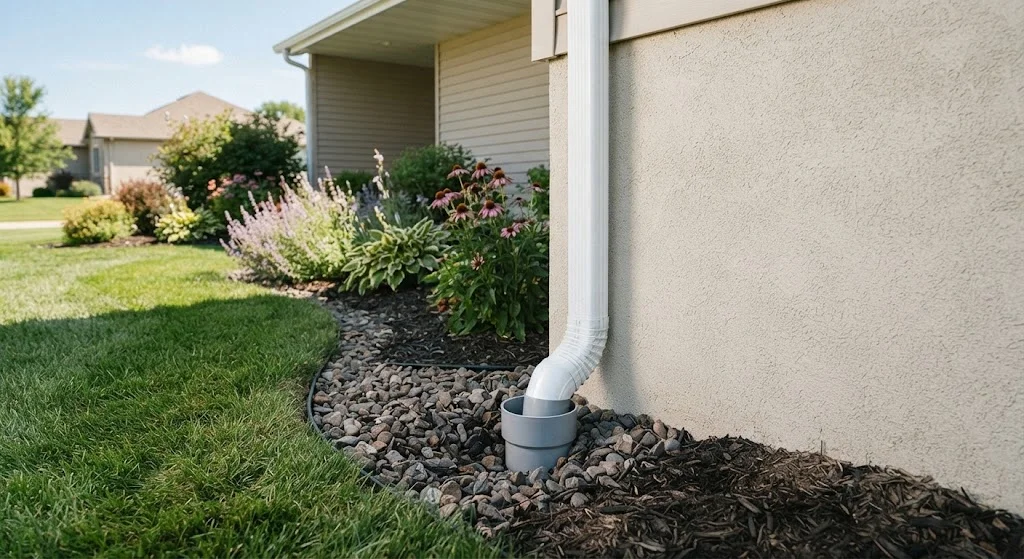
As part of our comprehensive residential and commercial gutter services in Topeka, our field specialists engineer complete subterranean gutter drainage solutions. We install solid-wall PVC underground pipe systems, catch basins, pop-up bubbler release emitters, and gravity-fed daylight discharges that transport roof runoff fifteen, twenty, or thirty feet away from your foundation footings.
Whether protecting an expansive estate near Lake Sherwood, resolving yard pooling in Westboro, or preserving historic foundation masonry in College Hill, our drainage installations provide permanent protection against water intrusion.
The Soil Science of Shawnee County: Why Surface Runoff Is Dangerous
Understanding why roof runoff must be moved far away from Topeka homes requires examining the local geological soil profile:
1. Expansive Clay Shrink-Swell Behavior
The clay sub-soils across Northeast Kansas have high plasticity indexes. When water from unextended downspouts dumps into the ground right next to the foundation, the clay absorbs water like a sponge and expands. This expansion exerts lateral hydrostatic pressure against basement walls. Over time, horizontal cracks develop in foundation walls, and water is forced through microscopic pores and mortar lines.
2. Differential Foundation Settling
When rain dumps concentrated water at one or two corners of a home while other sides remain relatively dry, the soil on the wet side expands while the dry side settles. This differential movement stresses the home's timber framing, resulting in sticking doors, jammed windows, cracked drywall along interior ceiling joints, and cracked exterior brick mortar.
3. Landscape and Topsoil Washouts
Concentrated runoff exiting a standard downspout elbow at high velocity during a severe storm scours away mulch, erodes costly landscaping topsoil, and exposes tree root systems. The resulting muddy trenches can undermine nearby concrete walkways, patio slabs, and driveways, causing them to crack and sink.
By pairing our high-capacity seamless gutter installation and oversized 3x4-inch downspouts with subterranean drainage lines, water is guided safely into designated discharge zones far from structural footings.
Solid PVC vs. Corrugated Flexible Pipe: Our Engineering Standard
A critical design choice in underground drainage is selecting the appropriate pipe material. Many low-cost landscape contractors install thin, black corrugated flexible tubing. In Northeast Kansas, corrugated tubing inevitably fails within three to five years:
Black Corrugated Flexible Pipe (The Flawed Alternative)
- Internal Friction and Ribs: The corrugated interior creates friction and turbulence, trapping roof shingle granules, pine needles, and decomposing organic silt in the bottom ridges.
- Crush Vulnerability: The thin plastic walls easily crush or deform under lawnmower traffic, vehicle tires, or seasonal frost heave.
- Root Intrusion: Flexible pipe joints cannot be solvent-welded; tree roots from oaks and maples quickly penetrate snap-together seams, completely blocking water flow.
- Cleaning Difficulty: Mechanical drain-cleaning snakes and high-pressure jetting nozzles easily shred the thin corrugated walls, making it impossible to clear root blockages.
Solid-Wall Schedule 40 or Heavy-Duty PVC (Our Standard)
- Smooth Hydraulic Interior: The mirror-smooth interior surface ensures that water and dislodged roof silt flow at maximum velocity without clinging to pipe walls.
- Crush Resistance: Heavy-wall PVC easily withstands driving lawnmowers, landscaping equipment, and freezing soil pressures without deflecting.
- Solvent-Welded Sealed Joints: All pipe joints and 45-degree sweeps are chemically bonded with PVC primer and solvent cement, forming an impenetrable barrier against tree root intrusion.
- Snake and Jetting Compatible: Solid PVC lines can be cleared with commercial rotary snakes or high-pressure water jetters decades after installation without damaging the pipe.
| Drainage Feature | Heavy-Duty Solid-Wall PVC Systems | Low-Cost Black Corrugated Tubing |
|---|---|---|
| Interior Surface | Ultra-smooth (zero debris retention) | Ribbed and corrugated (catches silt and seeds) |
| Joint Integrity | Solvent-welded glued joints (100% root-proof) | Snap-together friction fittings (easily penetrated by roots) |
| Structural Crush Rating | High (handles lawnmowers and vehicle traffic) | Very low (easily crushed by equipment or frost) |
| Slope Reliability | Rigid 10-foot lengths maintain exact grade | Flexible pipe sags, creating low pockets of standing water |
| Cleanout Capability | Fully cleanable with mechanical snakes and jetters | Cannot be snaked without tearing or puncturing pipe walls |
| System Lifespan | 50+ years of dependable performance | Fails or clogs in 3 to 7 years |
Components of an Underground Gutter Drainage System
Our subterranean drainage systems are engineered as closed-loop, gravity-fed assemblies designed for decades of trouble-free water evacuation:
1. Debris Filter Cleanout Boxes
At the base of the vertical downspout, we install a clean, attractive adapter or inline debris filter box. This box prevents leaves or twigs from entering the underground pipe and features an accessible cleanout door, allowing homeowners to inspect water flow without digging up the yard.
2. Laser-Graded Trenching
Using specialized mechanical trenchers, our crews excavate a narrow, clean trench sloping away from your foundation. We establish a minimum continuous downward slope of one-eighth to one-quarter inch per foot of run using digital laser transit levels, ensuring that gravity moves water quickly without stagnant pockets.
3. Pop-Up Bubbler Release Valves
At the termination point in your lawn, we install a green, low-profile pop-up bubbler release valve. When water flows through the underground pipe during a storm, hydrostatic pressure lifts the valve lid, allowing water to disperse smoothly across your turf. Once the rain stops and the pipe drains, a spring-loaded mechanism lowers the lid flush with the turf, allowing you to run your lawnmower directly over it without damage.
4. Daylight Gravity Discharges
On properties with natural sloping topography, such as hillside lots in College Hill or lakefront properties near Lake Sherwood, we route solid PVC lines to daylight at the bottom of the slope. We terminate the line with a protective rodent guard screen that prevents small animals, mice, or chipmunks from nesting inside the pipe during dry summer months.
Catch Basins, French Drains, and Yard Water Diversion
In addition to downspout tie-ins, many Topeka properties face complex yard drainage challenges where surface runoff from neighboring properties pools against basement walls or patio slabs. We integrate specialized surface drainage solutions into our gutter systems:
Catch Basins
We install heavy-duty polymer catch basins equipped with structural grates in low-lying turf areas, landscape beds, or at the base of sloped driveways. Surface stormwater enters the basin, passes through an internal silt basket, and connects directly into our main underground PVC discharge line.
French Drain Integration
For properties with chronically soggy soil along side yards or against retaining walls, we install subterranean French drains. These systems utilize perforated PVC pipes surrounded by washed drainage gravel and wrapped in heavy-duty geotextile filter fabric to intercept subsurface groundwater and direct it safely away from the home.
If your existing gutters are overflowing and contributing to yard puddles, learn how our crews restore proper trough capacity on our gutter repair service page.
Maintenance and Seasonal Care for Underground Drainage
To ensure your subterranean drainage lines operate reliably for decades, simple seasonal care is recommended:
- Spring Inspection: After the winter thaw, inspect the pop-up bubbler release valve in your lawn to ensure it opens freely and is not obstructed by turf overgrowth or compacted winter soil.
- Debris Cleanout: Clear any roof shingle granules or organic silt that collect inside the upper cleanout adapter box.
- Hydraulic Flush: During our routine gutter cleaning and flush services, our technicians run high-pressure water hoses through your underground lines to verify that discharge is swift and unhindered.
- Micro-Mesh Protection: Installing micro-mesh gutter guards at the roofline is the best way to protect underground drains, preventing tree leaves and twigs from ever reaching the subterranean pipes.
Frequently Asked Questions About Gutter Drainage
How far away from my house should downspouts discharge?
In Topeka's expansive clay soils, downspouts should discharge a minimum of ten feet away from basement foundation walls. On properties with severe grading challenges or previous basement water intrusion, we recommend extending subterranean lines fifteen to twenty-five feet away into designated landscape swales.
Will underground drain pipes freeze and burst in Kansas winters?
No. Because our solid PVC systems are installed with continuous gravity slope and terminate at open pop-up bubbler valves or daylight outlets, water does not sit stagnantly inside the pipe. Once a storm ends, the pipe drains completely empty, leaving no water to freeze or expand during winter cold snaps.
Will excavating a trench destroy my lawn?
Our crews take extreme care to preserve your landscaping. We use specialized sod-cutting equipment to slice and lift the top layer of turf in clean rolls. Once the trench is backfilled and mechanically compacted, we reinstall the original sod, leaving your lawn looking clean and undisturbed within a few weeks.
Protect Your Foundation With Professional Drainage Solutions
Do not allow roof runoff to pool against your foundation walls. Protect your home's structural integrity with subterranean downspout drainage engineered for Shawnee County clay soils. Contact our Topeka dispatch desk by phone or visit our contact page to arrange your comprehensive on-site diagnostic assessment and receive a clear written estimate.
Transparent Pricing and Assessment Disclosure
Project costs, linear footage rates, and repair estimates displayed or discussed are regional market benchmarks for Topeka, KS and surrounding Shawnee County communities. Estimates are for budgeting purposes only. Actual prices vary based on on-site conditions, fascia integrity, roof pitch, linear footage, corner miters, downspout runs, and accessibility.
Every service visit includes an on-site physical evaluation and a clear written estimate before any physical work commences. No surprise travel fees or unapproved billings.