Quick Key Takeaways – Gutter Cleaning
Comprehensive Gutter Cleaning and Hydraulic Downspout Flushing in Topeka
Regular gutter cleaning is an indispensable preventative maintenance procedure for any residential or commercial property in Northeast Kansas. Topeka is renowned for its lush urban tree canopy, with mature pin oaks, silver maples, American elms, and native cottonwoods dominating historic neighborhoods such as College Hill, Westboro, and Potwin Place. While these trees provide shade during hot Kansas summers, they produce an enormous volume of organic debris throughout the year: sticky spring bud tassels, helicopter seed pods, summer storm twigs, and heavy autumn leaves.
When gutters and downspouts are left uncleaned, this organic matter combines with dislodged roof shingle granules and environmental dust to form a dense, heavy organic compost. This sludge quickly plugs the narrow downspout drop outlets, transforming free-flowing eaves into stagnant, waterlogged troughs holding hundreds of pounds of static weight. The resulting overflow saturates sub-fascia framing, damages exterior soffits, causes soil erosion around foundation walls, and can flood basement spaces.
As part of our comprehensive residential and commercial gutter services in Topeka, our field specialists provide thorough, professional gutter cleaning and hydraulic downspout flushing that completely eliminates clogs and restores full water diversion performance.
The Hidden Dangers of Neglected Gutters in Shawnee County
Many homeowners underestimate the severe structural damage caused by clogged gutters until visible interior water leaks or structural rot occur. In our local climate, neglected troughs trigger a cascading series of exterior problems:
1. Rotted Sub-Fascia and Soffit Decay
When downspouts are clogged, rainwater has nowhere to go. It backs up in the trough, rising until it crests over the back lip of the gutter. Because the water is trapped behind the aluminum, it continuously saturates the wood sub-fascia board and roof rafter tails. Over time, wood-decay fungi thrive, rotting the structural backing and requiring costly carpentry work before gutters can be secured again.
2. Excessive Static Weight and Gutter Pull-Away
Water weighs approximately 8.3 pounds per gallon. A typical fifty-foot run of 5-inch gutter clogged with saturated leaves and trapped standing water can weigh in excess of three hundred to four hundred pounds. This massive dead load exerts severe pulling leverage on fasteners. Traditional spikes work loose from wet wood, causing the entire trough to sag, pitch backward, or tear completely free from the eave.
3. Basement Flooding and Foundation Settling
The predominant soil across Topeka and Shawnee County consists of expansive clay that expands when saturated and shrinks when dry. When thousands of gallons of water cascade over the front edge of clogged gutters, it dumps directly adjacent to the foundation walls. This creates intense lateral hydrostatic pressure that cracks basement foundation blocks, penetrates mortar joints, and floods finished basements. Proper drainage via clean gutters and downspouts and drainage diversion is your home's primary protection against foundation movement.
4. Winter Ice Dams and Roof Deck Water Intrusion
In winter, clogged gutters filled with frozen leaves and stagnant water accelerate ice dam formation. When melting snow runs down the warm roof deck and encounters a frozen, blocked gutter, it backs up beneath the lower courses of asphalt shingles. As water freezes and expands under the shingles, it lifts them, causing meltwater to leak into attic insulation, ceilings, and exterior wall cavities. For comprehensive protection strategies, read our technical ice dam prevention guide.
5. Pest Harbors and Mosquito Breeding Grounds
Wet, decomposing organic leaf sludge provides an ideal breeding habitat for pests. During Kansas summers, standing water in clogged troughs becomes a primary nursery for Culex mosquitoes, vectors for West Nile virus. Furthermore, birds, squirrels, mice, and carpenter ants frequently nest in the protected, moist leaf beds inside neglected gutters.
| Maintenance Parameter | Professional Hand-Clearing and Flush | Untrained DIY Ladder Cleaning |
|---|---|---|
| Debris Removal Method | Hand-scooped directly into heavy collection buckets | Blown with leaf blowers onto siding and landscaping |
| Downspout Clearing | Full high-pressure hydraulic hose flush to ground | Upper elbow poked with a stick (leaving underground clogs) |
| Property Protection | Ladder standoffs to prevent gutter rim crushing | Ladders leaned directly against fragile aluminum troughs |
| Roof Valley Inspection | Valleys and flashing hand-cleared of trapped pine needles | Eaves reached from ladder without clearing upper valleys |
| Fastener Check | Visual inspection of pitch and loose hidden screw hangers | No mechanical inspection of structural stability |
| Safety Standard | OSHA-compliant safety harnesses and professional gear | Dangerous ladder positioning on soft, unlevel turf |
Our Professional Gutter Cleaning Protocol
Our technicians follow a meticulous six-step cleanout protocol designed to leave your rainwater system completely clear while maintaining absolute cleanliness across your property:
Step 1: Secure Ladder Setup with Standoff Stabilizers
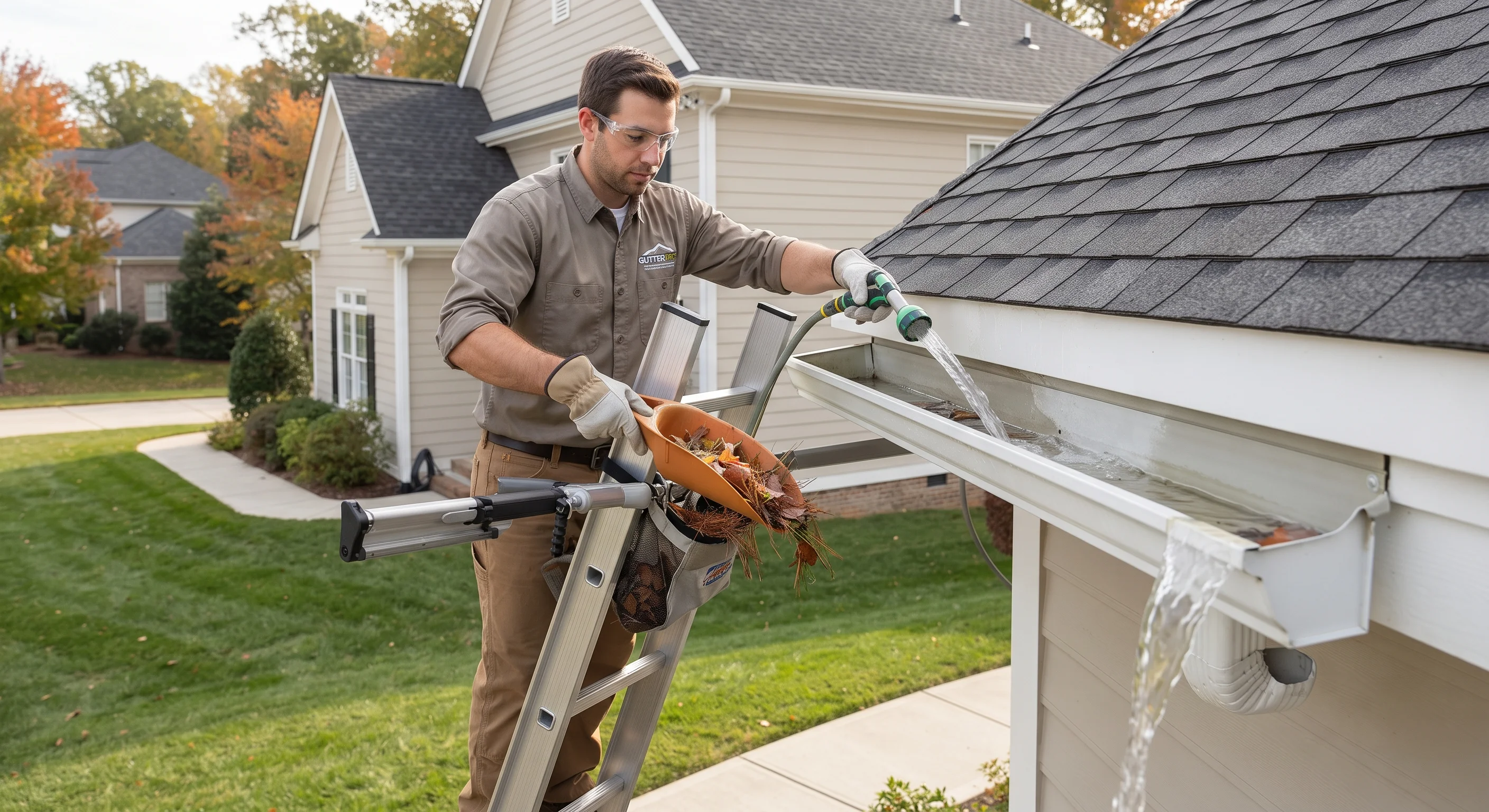
Safety and property protection begin at the ground. We inspect surrounding turf and concrete for level footing. Our extension ladders are equipped with wide, rubber-padded standoff stabilizers that rest safely against the roof decking, completely bridging over the gutter trough. This prevents ladder rails from denting, bending, or scratching your aluminum gutters.
Step 2: Hand-Removal of Bulk Organic Sludge
Unlike amateur contractors who use high-powered leaf blowers that blast wet, black sludge across your siding, windows, outdoor furniture, and clean landscaping beds, our technicians clear all bulk debris by hand. Using specialized gutter scoops, we remove leaves, twigs, decomposing silt, and shingle granules, placing the waste directly into heavy buckets secured to our ladder rigs.
Step 3: Roof Valley and Flashing Clearing
Clogs often originate higher up the roof plane. We clear all leaf dams and debris that accumulate in roof valleys, behind chimney flashings, and around skylight saddles, ensuring that rainwater flows freely into the eave troughs without obstruction.
Step 4: High-Pressure Hydraulic Downspout Flush
Removing debris from the horizontal trough is only half the battle. Decaying leaves frequently pack tightly inside the upper downspout elbows. We feed high-pressure water hoses down into each downspout drop outlet, blasting through packed clogs and flushing vertical runs down through the lower elbow. If your downspouts tie into underground drainage systems, we verify that water discharges freely from the pop-up bubbler release valves in the lawn.
Step 5: Pitch and Mechanical Fastener Inspection
While cleaning, our technician inspects the mechanical condition of your system. We check for loose spikes, sagging troughs, separated corner miters, and rotted sub-fascia boards. If minor issues are detected, we can perform targeted gutter repairs before structural damage occurs.
Step 6: Ground Cleanup and Responsible Disposal
We bag all collected organic waste and remove it from your property for municipal composting. Finally, our crews conduct a thorough ground inspection, rinsing off any accidental splatters and sweeping surrounding walkways and driveways so your property is left immaculate.
Recommended Cleaning Frequency for Topeka Homeowners
How often your gutters require cleaning depends on your property's surrounding tree canopy and environmental exposure:
- Heavy Hardwood Canopy (College Hill, Westboro, Potwin Place): Three cleanings per year. A late spring cleaning to remove oak tassels and maple seed pods, an early autumn cleaning during initial leaf drop, and a late autumn cleanout in late November after all oak and cottonwood leaves have fallen.
- Moderate Tree Coverage: Two cleanings per year. One in late spring and one in late autumn before the first hard winter freeze.
- Minimal Tree Coverage (Open Subdivisions in Silver Lake or Auburn): One cleaning per year in late autumn to flush out dislodged roof shingle granules, windblown prairie dust, and bird nesting debris.
For comprehensive seasonal maintenance guidance, consult our seasonal maintenance guide for Kansas.
Eliminate Ladder Cleaning: The Gutter Guard Alternative
Cleaning gutters from extension ladders presents one of the highest fall and injury risks for residential homeowners. If you are tired of scheduling recurring cleanouts or climbing ladders, consider installing our surgical-grade stainless steel micro-mesh gutter guards.
Our micro-mesh covers fit securely over your existing or new seamless gutters, blocking pine needles, seed pods, and oak tassels while capturing high-velocity storm runoff through capillary action. Review our transparent investment benchmarks on our gutter guards cost guide.
Transparent Pricing for Gutter Cleaning in Topeka
Our gutter cleaning rates are based on total linear footage, roof pitch complexity, and number of stories. We provide clear, itemized written estimates before any work begins, with zero hidden travel charges or surprise fees.
Review complete regional pricing factors in our dedicated gutter cleaning cost guide.
Frequently Asked Questions About Gutter Cleaning
Can you clean my gutters if I am not at home during the day?
Yes. As long as our technicians have clear exterior access around the perimeter of your property and outdoor water spigots are accessible for downspout flushing, we can complete the entire cleanout, downspout flush, and cleanup while you are away. We can leave a detailed completion report and invoice.
Do you use leaf blowers to clean gutters?
No. High-velocity leaf blowers spray wet, decomposing organic sludge across exterior siding, windows, patios, and landscaping beds, creating a massive mess. Our technicians scoop out all organic sludge by hand and bag it cleanly, followed by a controlled water flush.
What happens if my downspout is clogged below the ground?
Our technicians use specialized plumber snakes and high-pressure jetting nozzles to clear stubborn blockages inside underground drain pipes. If an underground pipe has collapsed from tree root intrusion or soil compaction, we can provide a written proposal to repair or replace the underground drainage line.
Schedule Your Professional Gutter Cleanout Today
Keep your roofline clear, your sub-fascia protected, and your basement dry. Call our Topeka dispatch desk today or visit our contact page to schedule your professional gutter cleaning and receive a clear written estimate.
Transparent Pricing and Assessment Disclosure
Project costs, linear footage rates, and repair estimates displayed or discussed are regional market benchmarks for Topeka, KS and surrounding Shawnee County communities. Estimates are for budgeting purposes only. Actual prices vary based on on-site conditions, fascia integrity, roof pitch, linear footage, corner miters, downspout runs, and accessibility.
Every service visit includes an on-site physical evaluation and a clear written estimate before any physical work commences. No surprise travel fees or unapproved billings.