Quick Key Takeaways – Downspouts
High-Capacity Downspout Systems and Foundation Protection in Topeka
A rain gutter system is only as effective as the vertical downspout assemblies that evacuate water from the roofline and discharge it away from the building. In Topeka and surrounding Shawnee County, exterior drainage assemblies must process immense volumes of stormwater generated by sudden convective prairie cloudbursts. When a thunderstorm drops two inches of rain in forty-five minutes, thousands of gallons of water rush toward downspout drop outlets. If downspouts are undersized, poorly positioned, or restricted by sharp bends, water backs up into the eave troughs, spilling over the front rim and saturating sub-fascia framing.
Even more critically, how downspouts discharge at the ground level dictates the structural health of your foundation. The predominant soil throughout Topeka consists of expansive clay that expands when saturated and contracts during dry summer periods. Depositing hundreds of gallons of roof runoff directly at the base of a foundation wall creates intense hydrostatic pressure, resulting in cracked basement walls, chronic dampness, and severe settling.
As part of our comprehensive residential and commercial gutter services in Topeka, our field specialists engineer high-capacity downspout systems. We install oversized 3x4-inch corrugated downspouts, custom architectural offsets, hinged flip-up extensions, and seamless tie-ins to underground gutter drainage systems that transport water ten to twenty feet away from your foundation footings.
Whether you are upgrading drainage on a historic estate in College Hill, redirecting downspouts away from patio slabs in Westboro, or outfitting a custom property near Lake Sherwood, our downspout solutions ensure rapid, safe water evacuation.
The Physics of Downspout Sizing: 2x3 vs. 3x4 Oversized Pipes
For decades, standard residential construction relied on narrow 2x3-inch rectangular downspouts. While acceptable in regions with light, steady drizzle, 2x3 downspouts create a severe hydraulic bottleneck under Midwest storm conditions.
Standard 2x3 Downspouts
- Cross-Sectional Area: Only 6 square inches of internal discharge capacity.
- Debris Vulnerability: Small leaves, oak catkins, or twigs easily lodge in the narrow upper elbow, causing immediate blockages that trap water in the trough above.
- Water Volume Rating: Rated to drain up to 600 square feet of roof area under moderate rainfall rates.
Oversized 3x4 Corrugated Downspouts (Our Standard)
- Cross-Sectional Area: A full 12 square inches of internal discharge capacity—a 100 percent increase in volume over 2x3 pipes.
- Clog Resistance: The larger cross-section allows wet leaves, small twigs, and seed pods to wash freely through upper elbows and discharge safely at the ground without jamming.
- Water Volume Rating: Easily drains up to 1,200 square feet of roof drainage area per downspout, accommodating torrential convective storms without water backing up into eaves.
| Downspout Dimension | Cross-Sectional Area | Maximum Roof Drainage Area | Clog Susceptibility | Storm Drainage Capacity |
|---|---|---|---|---|
| Standard 2x3-Inch | 6.0 square inches | Up to 600 sq ft of roof area | High (leaves bridge across narrow elbows) | Overwhelmed during heavy Kansas prairie cloudbursts |
| Oversized 3x4-Inch | 12.0 square inches | Up to 1,200 sq ft of roof area | Extremely Low (flushes organic debris cleanly) | Handles intense multi-inch-per-hour thunderstorm rates |
| Commercial 4x5-Inch | 20.0 square inches | Up to 2,000+ sq ft of roof area | Virtually Zero (commercial box applications) | Maximum industrial capacity for expansive commercial roofs |
| Round Corrugated (4") | 12.6 square inches | Up to 1,250 sq ft of roof area | Low (smooth hydraulic flow profile) | Ideal for historic half-round copper and aluminum profiles |
To calculate the exact downspout ratio required for your roof pitch and square footage, consult our comprehensive gutter sizing calculator guide.
Precision Elbow Offsets and Wall Transitions
Homes in Shawnee County feature diverse architectural finishes, including brick water tables, exterior stone ledges, overhanging soffits, and decorative trim bands. Navigating these architectural projections requires custom downspout elbow fabrication.
A-Style vs. B-Style Elbows
- A-Style Elbows: Bend forward and backward along the wide 4-inch face of the downspout. These are primarily used to transition the downspout from the roof eave back against the flat exterior wall.
- B-Style Elbows: Bend side-to-side along the narrow 3-inch face of the downspout. These are utilized to maneuver around exterior chimneys, window trim, or outside corner walls.
Our technicians custom-fit every transition using commercial crimping tools, ensuring that upper male joints always slip downward inside lower female joints. This telescoping orientation ensures that water remains entirely within the aluminum pipe without leaking out of joint seams. Every connection is secured with stainless steel zip screws, preventing wind vibration from dislodging vertical sections.
If an existing downspout has separated at an upper elbow, learn how our crews repair it on our dedicated gutter repair service page.
Foundation Water Diversion: Extensions and Discharge Solutions
Allowing downspouts to dump stormwater directly at the corner of your home is a major structural hazard. When hundreds of gallons of water discharge next to foundation footings, the saturated clay soil expands, exerting massive lateral pressure that cracks basement walls and causes chronic moisture problems.
We engineer three primary downspout discharge solutions to keep water far away from your foundation:
1. Hinged Flip-Up Downspout Extensions
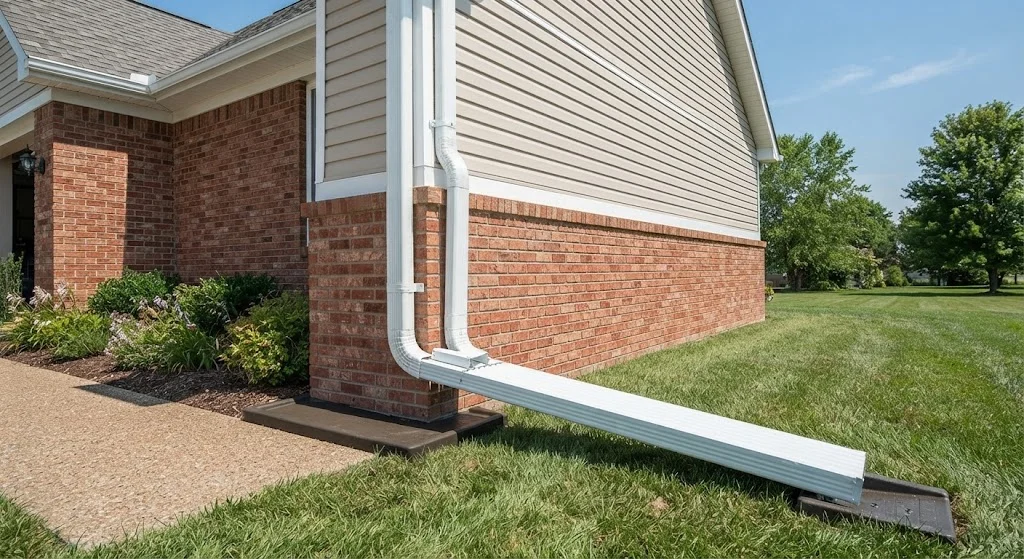
For downspouts that discharge into manicured turf or garden beds, hinged flip-up extensions provide an ideal balance of protection and convenience. We install custom aluminum extensions that extend six to ten feet away from the foundation. A heavy-duty aluminum swivel hinge allows you to easily flip the extension upward to a vertical position when mowing your lawn or performing landscape maintenance.
2. Heavy-Duty Splash Blocks and Dissipators
In areas where underground piping is not feasible, we position heavy composite or concrete splash blocks beneath lower downspout elbows. These blocks feature textured channels that absorb the kinetic energy of falling water, preventing topsoil erosion and directing the flow outward onto sloping turf.
3. Underground Drainage Transitions and Bubbler Release Valves
For maximum protection and a clean landscape appearance, we connect vertical downspouts directly to solid PVC underground drain pipes. Water flows beneath the lawn via gravity, depositing runoff fifteen to twenty-five feet away through a pop-up bubbler release valve or daylight outlet. Learn more about our subterranean systems on our gutter drainage service page.
Architectural Profiles and Materials: Matching Your Home's Aesthetic
Downspouts should complement your property's exterior style. We provide downspouts in a full range of materials and architectural profiles:
- Seamless Aluminum (Corrugated or Smooth): Available in more than twenty baked-on enamel colors that match your seamless gutter installation or siding trim.
- Architectural Copper Downspouts: For historic Victorian and Craftsman homes in Potwin Place and College Hill, we hand-craft round corrugated or smooth round downspouts in 16-ounce architectural copper, accented with decorative cast brass wall brackets. Explore natural copper systems in our copper gutters guide.
- Commercial Steel Downspouts: Heavy-gauge Galvalume or galvanized steel downspouts designed to withstand impact along high-traffic commercial loading docks and school perimeters.
Downspout Maintenance: Preventing Elbow Clogs
While oversized 3x4 downspouts are significantly more clog-resistant than narrow 2x3 pipes, homes surrounded by dense oak and pine canopies can still experience clogs if large twigs or pine clusters become wedged in lower elbows.
During our routine gutter cleaning and flush services, our technicians use high-pressure hydraulic hoses to clear vertical downspouts from drop outlet to ground discharge. To permanently prevent leaf and twig debris from entering downspouts, we recommend installing surgical-grade micro-mesh gutter guards.
Frequently Asked Questions About Downspouts
How many downspouts does my home need?
As a general engineering rule for Shawnee County, we install one oversized 3x4 downspout for every thirty to forty linear feet of gutter trough. However, homes with steep roof pitches, large intersecting valleys, or high surface collection areas may require additional downspout drop outlets to ensure rapid water evacuation during severe thunderstorms.
Can you replace my narrow 2x3 downspouts with 3x4 downspouts without replacing my gutters?
Yes. Our technicians can enlarge the drop outlets on your existing gutters using specialized sheet metal notchers, install commercial transition funnels, and mount new oversized 3x4 downspouts, doubling your drainage capacity without replacing your entire gutter system.
Why do my downspouts make a loud dripping sound at night?
Loud dripping noises occur when water drops from the upper outlet and strikes the metal bottom of the lower elbow. Our technicians can adjust the elbow angle or install specialized acoustic foam pads or turf-textured diverters inside the lower elbow to eliminate distracting dripping sounds.
Upgrade Your Downspout Drainage in Topeka Today
Protect your foundation, basement walls, and sub-fascia with oversized downspouts engineered for heavy Kansas storms. Contact our Topeka dispatch desk by phone or visit our contact page to arrange your comprehensive on-site diagnostic assessment and receive a clear written estimate.
Soil Protection and Hydrostatic Pressure Reduction in Topeka
In Shawnee County, downspout extensions play a decisive role in long-term foundation health. Topeka's clay-rich subsoils undergo dramatic volume changes between saturated wet conditions and arid summer droughts. When roof downspouts deposit thousands of gallons of stormwater directly against foundation footings, the soil expands unevenly, placing intense hydrostatic pressure against basement walls.
By extending downspouts at least six to ten feet away from exterior walls or connecting them to underground drain pipes leading to pop-up bubbler emitters, property owners safeguard basement integrity and eliminate soil trenching. Pair your downspout upgrade with a high-capacity seamless gutter installation to complete your property's exterior drainage envelope.
Transparent Pricing and Assessment Disclosure
Project costs, linear footage rates, and repair estimates displayed or discussed are regional market benchmarks for Topeka, KS and surrounding Shawnee County communities. Estimates are for budgeting purposes only. Actual prices vary based on on-site conditions, fascia integrity, roof pitch, linear footage, corner miters, downspout runs, and accessibility.
Every service visit includes an on-site physical evaluation and a clear written estimate before any physical work commences. No surprise travel fees or unapproved billings.