Quick Key Takeaways – Gutter Maintenance
Comprehensive Preventative Gutter Maintenance in Topeka, Kansas
While routine cleaning clears leaves and organic sludge from gutter troughs, true preventative maintenance involves a far more rigorous technical evaluation of your entire rainwater management assembly. In Topeka and throughout Shawnee County, exterior eaves are subjected to continuous environmental stress: severe spring convective thunderstorms, straight-line prairie winds, rapid summer thermal expansion, and heavy winter freeze-thaw cycles that place enormous pulling leverage on mechanical fasteners.
Without systematic preventative care, minor mechanical issues—such as a single loose hanger, a microscopic hairline crack in corner miter sealant, or a half-inch of negative pitch—silently escalate into catastrophic failures. Stagnant water trapped along an improperly sloped trough rots the sub-fascia board, encourages mold colonization in attic soffits, and creates foundation soil erosion. As part of our comprehensive residential and commercial gutter services in Topeka, our field specialists deliver structured preventative maintenance programs that preserve hydraulic performance and extend the lifespan of your exterior drainage systems.
Whether maintaining a sprawling residential estate in Westboro, preserving historic architectural half-round gutters in Potwin Place, or protecting a multi-story home near Lake Sherwood, our experienced technicians provide meticulous care tailored to your roofline.
Preventative Maintenance vs. Reactive Gutter Cleaning
Many homeowners treat gutter care as an emergency response: they only look up at their eaves when water is actively pouring over the front lip during a torrential downpour. However, by the time overflow is visible, internal structural damage has often already begun. Understanding the difference between simple cleaning and comprehensive maintenance is essential:
| Service Parameter | Simple Routine Gutter Cleaning | Comprehensive Preventative Maintenance |
|---|---|---|
| Primary Objective | Remove bulk leaves, twigs, and surface debris | Verify mechanical integrity, slope accuracy, and seal durability |
| Debris Management | Hand-scoop organic sludge from trough floors | Clear debris plus deep flush of all vertical downspouts and drains |
| Slope Verification | Visual check of standing water | Laser-level verification of quarter-inch per 10-foot downward pitch |
| Fastener Service | None (spikes and clips left untouched) | Torque loose hidden screw hangers into rafter tails; replace failing spikes |
| Sealant Inspection | None (joints and miters not examined) | Clean and reseal corner miters, end caps, and drop outlets with polyurethane |
| Sub-Fascia Evaluation | Not performed | Non-invasive moisture meter testing of wood framing behind the trough |
| Flashing Integration | Ignored | Verify metal drip edge overlap beneath lower shingles into trough |
| Long-Term Protection | Temporary fix lasting 3 to 6 months | Extends overall system lifespan by 10 to 15+ years |
If your system already exhibits physical sagging, detached brackets, or chronic seam leaks, explore our corrective procedures on our dedicated gutter repair service page.
The 8-Point Preventative Maintenance Protocol
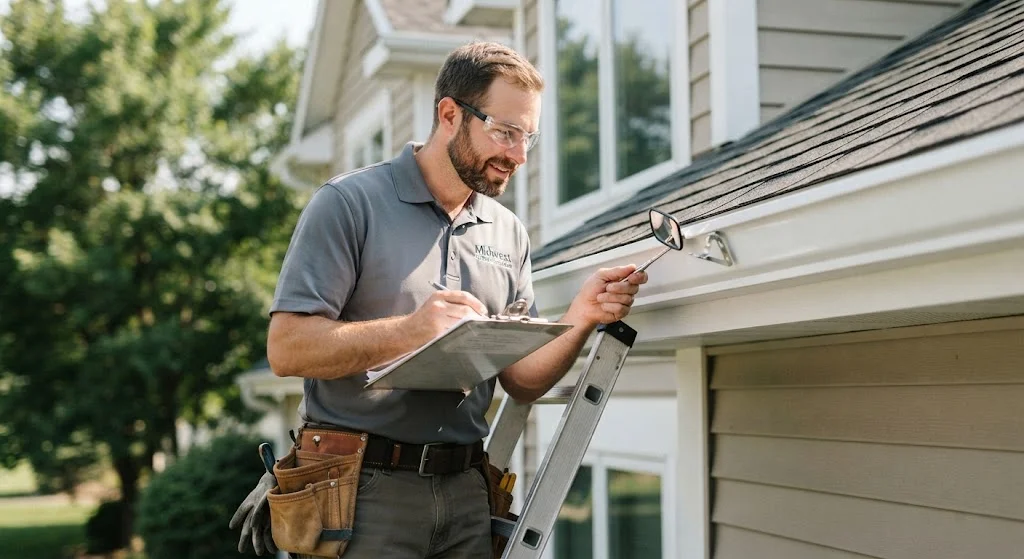
During a scheduled maintenance visit, our diagnostic technicians perform an exhaustive multi-point technical inspection across your entire roofline:
1. Laser-Level Pitch Recalibration
Gutter runs must maintain a consistent downward slope of at least one-quarter inch for every ten feet of horizontal run toward the downspout drop outlet. Over time, building settling, roof framing movement, and winter ice loads can distort this pitch, causing water to pool mid-span. Our technicians test the run with precision digital levels and adjust hanger elevations to restore rapid, gravity-fed drainage.
2. Fastener Torque and Structural Hanger Inspection
We examine every internal hanger along the gutter perimeter. Older spikes that have worked loose from wood framing are removed and replaced with heavy-duty hidden screw hangers driven with two-inch zinc-coated structural screws directly into rafter tails. We verify that all screw hangers are torqued securely without overtightening, which could distort the aluminum trough.
3. Elastomeric Polyurethane Sealant Renewal
Corner miters and end caps are subjected to continuous thermal movement as intersecting roof eaves expand and contract during Kansas seasons. We inspect all joint seams for microscopic cracks or bond separation. Any degraded sealant is scraped clean, prepped with solvent, and recoated with commercial-grade elastomeric polyurethane sealant that remains flexible down to minus-forty degrees Fahrenheit.
4. Sub-Fascia Wood Rot Moisture Probing
Water leaking over the back lip of a gutter can rot the wood sub-fascia board while the front of the gutter looks completely normal. Our technicians use electronic moisture probes to test the structural density of the wood behind the troughs. Early detection of moisture softens allows homeowners to perform targeted localized repairs before complete sub-fascia failure necessitates full gutter replacement.
5. Metal Drip Edge Flashing Alignment
We verify that the metal roof drip edge extends cleanly over the back wall of the gutter trough. If the flashing is bent upward or lacks proper overlap, surface tension draws roof runoff backward underneath the roof decking, damaging fascia and encouraging mildew growth in attic soffits. We re-align or install custom aluminum flashing extensions wherever necessary.
6. Hydraulic Downspout and Outlet Clearing
We clear all drop outlets and perform a high-pressure hydraulic flush of every vertical downspout. We inspect elbow seams for crimp separation and verify that all wall-mounting brackets are firmly anchored into exterior siding or masonry mortar joints.
7. Ground Drainage and Discharge Path Inspection
A gutter system that deposits water directly next to the basement wall defeats its own purpose. We inspect splash blocks, hinged extensions, and connections to underground drainage systems to ensure stormwater is discharged at least ten feet away from the foundation perimeter.
8. Micro-Mesh Gutter Guard Tune-Up
If your property is equipped with micro-mesh gutter guards, our technicians inspect the filter screens for surface silt, pine resin, or physical impact damage from fallen branches. We brush the mesh clean, inspect the internal brackets, and verify that capillary water-draw remains unobstructed.
Seasonal Maintenance Calendar for Shawnee County Properties
To keep your rainwater management system operating at peak performance throughout the year, our technicians recommend following this Kansas seasonal maintenance schedule:
Early Spring (March – April): Post-Winter Recovery and Storm Prep
- Inspect eaves for winter ice dam damage, crushed troughs, or loosened hidden hangers.
- Clear windblown prairie debris, twigs, and early bud scales from roof valleys.
- Verify that downspout discharge extensions are connected and routed away from thawing topsoil before heavy spring thunderstorm cycles begin.
Late Spring (May – June): Seed and Tassel Mitigation
- Clear sticky oak catkins, cottonwood fuzz, and maple helicopter seeds from gutters and guard screens.
- Perform a high-pressure water test to confirm that drop outlets are fully open and ready for severe convective rainfall.
Early Autumn (September – October): Pre-Frost Preparation
- Clear early deciduous leaf shedding from pin oaks, maples, and ash trees.
- Inspect and touch up corner miter sealants before freezing winter temperatures arrive.
Late Autumn (November – December): Final Freeze-Thaw Winterization
- Perform a thorough final gutter cleaning and flush after the final deciduous leaf drop.
- Ensure all troughs are completely dry and free of standing water that could freeze into solid ice blocks, stressing fasteners and warping aluminum walls.
- Review our specialized Kansas winter recommendations in our ice dam prevention guide.
The True Cost of Deferred Maintenance
Deferring exterior gutter maintenance is one of the costliest mistakes a property owner can make. While scheduled maintenance represents a modest seasonal investment, the structural damage caused by neglected drainage systems runs into thousands of dollars:
- Sub-Fascia and Rafter Tail Rot: Replacing decayed structural wood framing along an eave requires specialized carpentry, costing $1,500 to $4,500+ depending on the perimeter length.
- Basement Foundation Seepage: Correcting hydrostatic basement wall bowing, waterproofing cracked concrete block walls, and installing internal sump pump systems frequently costs between $6,000 and $15,000+.
- Landscape Soil Erosion: Repairing foundation topsoil washouts, replacing flooded garden beds, and re-grading settled walkways adds substantial exterior expense.
Proactive maintenance protects your equity and ensures your drainage system delivers its full thirty-year service life. Review complete cost considerations on our gutter repair cost guide.
Frequently Asked Questions About Gutter Maintenance
How is maintenance different from a standard gutter cleanout?
A standard cleanout simply removes leaves and debris from the trough. Comprehensive maintenance includes structural pitch verification with digital levels, torquing loose hidden hangers into rafter tails, resealing corner miters with commercial polyurethane, testing sub-fascia boards for moisture rot, and verifying roof drip edge overlap.
How often should my Topeka home receive preventative gutter maintenance?
We recommend scheduling a comprehensive maintenance inspection at least twice per year: once in the spring following the winter thaw to prepare for severe thunderstorm season, and once in late autumn after the final leaf drop to winterize the roofline.
Can you perform maintenance on older sectional gutters?
Yes. We service all types of gutter systems, including older sectional steel, vinyl, and aluminum. While older sectional gutters require more frequent joint resealing than modern continuous seamless gutters, routine maintenance significantly extends their remaining useful service life.
Schedule Your Preventative Gutter Maintenance Today
Protect your home against the extremes of Kansas weather with structured preventative care. Contact our Topeka dispatch desk by phone or visit our contact page to arrange your comprehensive on-site maintenance inspection and receive an itemized clear estimate today.
Transparent Pricing and Assessment Disclosure
Project costs, linear footage rates, and repair estimates displayed or discussed are regional market benchmarks for Topeka, KS and surrounding Shawnee County communities. Estimates are for budgeting purposes only. Actual prices vary based on on-site conditions, fascia integrity, roof pitch, linear footage, corner miters, downspout runs, and accessibility.
Every service visit includes an on-site physical evaluation and a clear written estimate before any physical work commences. No surprise travel fees or unapproved billings.